

Choosing between a diamond grinding wheel and a CBN grinding wheel is not simply a matter of selecting the harder abrasive. The correct choice depends primarily on the workpiece material, its chemical and thermal characteristics, and the grinding process. An unsuitable abrasive may lead to excessive wheel wear, poor cutting efficiency, inconsistent surface finish, and higher manufacturing costs.
At Sea Shore Diamond Industrial Co., Ltd. (SSDC), diamond and CBN grinding tools serve precision grinding applications involving tungsten carbide, hardened steels, ceramics, glass, and other difficult-to-machine materials. Understanding the differences between these two superabrasives helps manufacturers identify suitable grinding wheel specifications before considering grit size, bond type, and wheel geometry.
Table of Contents
- What Is the Difference Between Diamond and CBN Grinding Wheels?
- Diamond vs. CBN: Material Selection Chart
- When Should You Use Diamond Grinding Wheels?
- When Should You Use CBN Grinding Wheels?
- Why Is Diamond Generally Not Recommended for Grinding Steel?
- What Other Factors Affect Grinding Wheel Selection?
- Common Grinding Wheel Selection Scenarios
- How to Choose the Right Grinding Wheel for Your Application
- Diamond and CBN Grinding Solutions from SSDC
- Frequently Asked Questions
1. What Is the Difference Between Diamond and CBN Grinding Wheels?
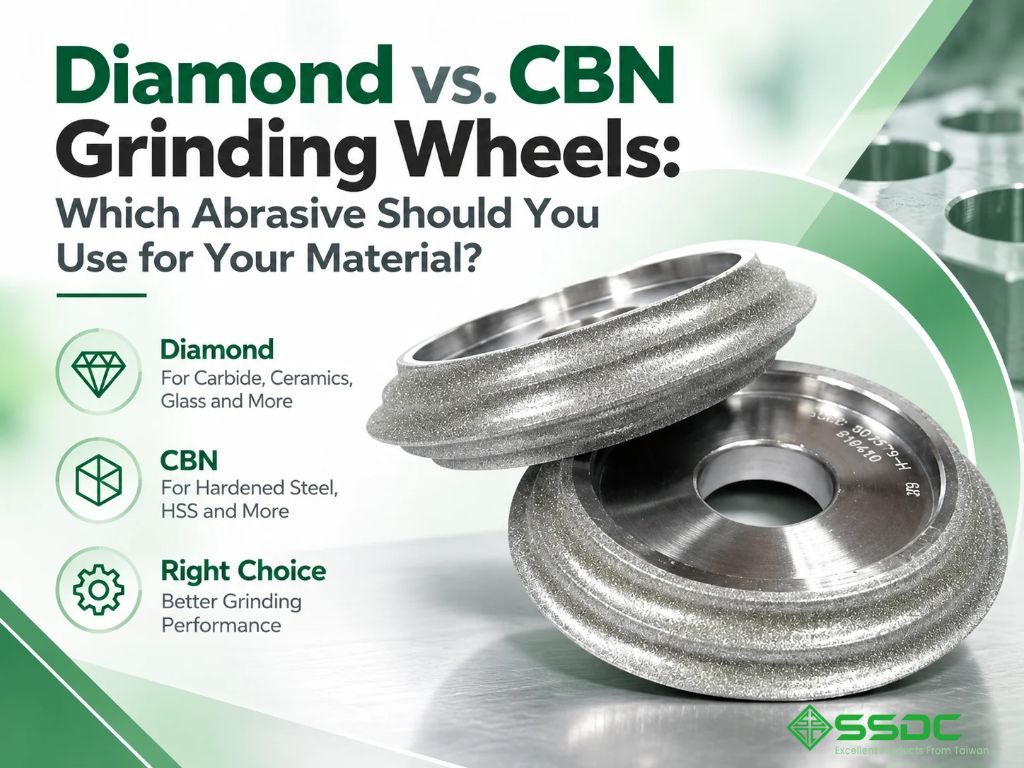
Diamond and cubic boron nitride (CBN) are both superabrasives used for grinding materials that require high abrasive hardness and wear resistance. However, their different chemical and thermal properties make them suitable for different workpiece materials.
Diamond Grinding Wheels
Diamond is the hardest known natural material and offers excellent abrasive performance when grinding many hard, brittle materials.
Diamond grinding wheels are commonly selected for tungsten carbide, ceramics, glass, quartz, and other compatible non-ferrous materials.
However, diamond is not generally the preferred abrasive for conventional grinding of steels because of its chemical interaction with iron at elevated grinding temperatures.
CBN Grinding Wheels
CBN, or cubic boron nitride, is another extremely hard abrasive. Although it is slightly softer than diamond, it offers excellent thermal stability and greater chemical compatibility with ferrous materials.
These properties make CBN particularly useful for grinding hardened steel, high-speed steel, tool steel, and bearing steel.
Diamond vs. CBN: Key Differences
| Comparison | Diamond Grinding Wheel | CBN Grinding Wheel |
|---|---|---|
| Abrasive Material | Diamond | Cubic Boron Nitride |
| Relative Hardness | Higher | Slightly lower |
| Typical Material Compatibility | Carbides, ceramics, glass, hard non-ferrous materials | Hardened steels and other suitable ferrous materials |
| Chemical Compatibility with Iron | Generally unfavorable at elevated temperatures | More favorable |
| Typical Applications | Carbide tool grinding, ceramic finishing, glass processing | HSS tool sharpening, hardened steel grinding, bearing components |
| Primary Selection Consideration | Compatibility with hard and brittle materials | Thermal stability and compatibility with hardened ferrous materials |
The most important difference is not which abrasive is harder, but which abrasive is better suited to the workpiece material and grinding conditions.
2. Diamond vs. CBN: Material Selection Chart
For manufacturers selecting a grinding wheel, identifying the workpiece material is the most useful starting point.
| Workpiece Material | General Abrasive Recommendation | Selection Consideration |
|---|---|---|
| Tungsten Carbide | Diamond | High hardness and effective carbide grinding |
| High-Speed Steel (HSS) | CBN | Suitable for hardened ferrous cutting tools |
| Hardened Tool Steel | CBN | Thermal stability and compatibility with iron-based materials |
| Bearing Steel | CBN | Precision grinding of hardened bearing components |
| Precision Ceramics | Diamond | Suitable for hard and brittle materials |
| Optical Glass | Diamond | Precision material removal and edge processing |
| Quartz | Diamond | Hard and brittle mineral material |
| Sapphire | Diamond | High hardness and precision grinding requirements |
| Nickel-Based Superalloys | Application-dependent; CBN may be considered | Evaluate alloy composition, wheel specification, and grinding conditions |
This table provides general abrasive-selection guidance, not a guarantee that one wheel specification will suit every process.
For example, grinding a tungsten carbide cutting tool and grinding a hardened steel cutting tool may involve similar machine operations, but their abrasive requirements are different.
3. When Should You Use Diamond Grinding Wheels?
Diamond grinding wheels are generally selected when the workpiece is extremely hard, brittle, or otherwise compatible with diamond abrasives.
Grinding Tungsten Carbide
Tungsten carbide is widely used in cutting tools, dies, molds, and wear-resistant industrial components.
Its high hardness makes abrasive selection particularly important. Diamond grinding wheels can provide effective material removal while supporting the precision required for tool manufacturing and regrinding.
Common applications include:
- Carbide cutting tool sharpening
- Tungsten carbide die grinding
- Precision profile grinding
- Carbide component finishing
The appropriate bond, grit size, and wheel shape depend on the operation.
For more information, read Why Diamond Grinding Wheels Are Preferred for Grinding Tungsten Carbide.
Grinding Ceramics, Glass, and Quartz
Ceramics, optical glass, and quartz are hard materials that can be susceptible to chipping or cracking during grinding.
Diamond abrasives are commonly used for these materials, but abrasive hardness alone does not determine the result.
Wheel specification, grinding force, feed rate, cooling conditions, and machine stability must also be considered.
For brittle workpieces, the objective is to achieve the required material removal while controlling edge damage and surface defects.
Grinding Sapphire and Other Advanced Materials
Diamond grinding wheels are also used for suitable advanced materials, including sapphire and certain semiconductor-related materials.
These applications may require careful control of surface quality, dimensional accuracy, and subsurface damage.
4. When Should You Use CBN Grinding Wheels?
CBN grinding wheels are generally selected for hardened ferrous materials, especially where precision grinding requires high abrasive wear resistance and controlled thermal performance.
Grinding High-Speed Steel
High-speed steel is commonly used for drills, end mills, cutting tools, and other tooling applications.
Because HSS is an iron-based material, CBN is generally more suitable than diamond for grinding hardened HSS tools.
Typical applications include tool sharpening, profile grinding, and precision finishing.
Grinding Hardened Tool Steel
Tool steels are used in molds, dies, punches, and industrial cutting components.
After heat treatment, these materials may require precision grinding to achieve their final dimensions and surface finish.
CBN grinding wheels are frequently considered because of their suitability for hardened ferrous materials.
Grinding Bearing Steel
Bearing components often require controlled geometry, dimensional consistency, and appropriate surface integrity.
CBN wheels can be used in suitable bearing steel grinding operations, including cylindrical and other precision grinding processes.
However, wheel performance still depends on factors such as machine rigidity, coolant delivery, grinding parameters, and bond selection.
Grinding Nickel-Based Superalloys
Certain nickel-based superalloys can also be processed using CBN grinding wheels.
However, these materials should not automatically be treated the same as hardened steels. Their grinding behavior varies with alloy composition, heat resistance, and process conditions.
The choice between CBN and other abrasives should therefore be evaluated for the specific application.
5. Why Is Diamond Generally Not Recommended for Grinding Steel?
Although diamond is harder than CBN, it is generally not the preferred abrasive for grinding conventional ferrous steels.
The reason is chemical compatibility.
At elevated grinding temperatures, diamond can experience accelerated wear through interactions involving carbon and iron. As a result, its exceptional hardness does not necessarily translate into longer wheel life when grinding steel.
CBN has greater chemical stability in contact with iron and maintains useful abrasive properties at high grinding temperatures.
This explains why CBN is commonly used for hardened steel grinding even though diamond is the harder abrasive.
There are specialized processes and exceptions, so this should be understood as a general industrial selection principle rather than an absolute prohibition.
6. What Other Factors Affect Grinding Wheel Selection?
After identifying the appropriate abrasive, manufacturers must determine which grinding wheel specification matches their process.
Grit Size
Grit size affects material removal and surface finish.
Relatively coarse grits may be considered for higher material removal requirements, while finer grits are often used for precision finishing.
However, selecting the finest grit does not automatically produce the best overall result. Grinding efficiency, wheel loading, and process stability must also be evaluated.
Bond Type
The bond holds abrasive grains in the grinding wheel and influences grain retention, wear behavior, and cutting performance.
Common diamond and CBN wheel bond systems include:
| Bond Type | General Characteristics | Typical Selection Consideration |
|---|---|---|
| Resin Bond | Relatively resilient cutting behavior | Tool sharpening, precision finishing, surface grinding |
| Electroplated Bond | Single abrasive layer with exposed cutting grains | Profile grinding, form retention, specialized geometries |
| Metal Bond | Strong grain retention and wear resistance | Applications requiring durability and form stability |
| Vitrified Bond | Rigid structures with controlled porosity, depending on design | Precision grinding where dressing and process control are important |
These characteristics are general guidelines. Actual performance depends on the specific wheel construction and grinding conditions.
Wheel Geometry
Grinding wheel geometry should match the machine and the contact area required by the workpiece.
For example, surface grinding, cylindrical grinding, profile grinding, and tool sharpening may require different wheel shapes.
A suitable abrasive with an unsuitable wheel geometry can still produce inefficient or unstable grinding results.
Operating Conditions
Important conditions include grinding speed, feed rate, depth of cut, machine rigidity, and cooling.
These factors affect heat generation, abrasive wear, material removal, and final surface quality.
The wheel must always be operated within its specified speed and safety limits.
7. Common Grinding Wheel Selection Scenarios
The following examples illustrate how workpiece material can influence abrasive selection in practical manufacturing situations.
Scenario 1: Regrinding Tungsten Carbide End Mills
Recommended Starting Point: Diamond Grinding Wheel
Tungsten carbide is highly wear-resistant and requires an abrasive capable of grinding hard carbide material.
The manufacturer should evaluate diamond wheel grit size, bond type, tool geometry, and required cutting-edge finish.
Scenario 2: Sharpening HSS Cutting Tools
Recommended Starting Point: CBN Grinding Wheel
HSS is a hardened ferrous material. CBN is generally preferred because of its chemical compatibility and thermal stability.
Wheel selection should also account for tool profile, stock removal, and required edge quality.
Scenario 3: Grinding Precision Ceramic Components
Recommended Starting Point: Diamond Grinding Wheel
Ceramics can be hard and brittle. Diamond abrasives are commonly selected, but process parameters must be controlled to reduce chipping and surface damage.
Scenario 4: Finishing Hardened Bearing Steel Components
Recommended Starting Point: CBN Grinding Wheel
CBN is commonly used for suitable hardened bearing steel grinding applications.
The final specification should reflect the grinding method, dimensional requirements, surface finish, and production conditions.
These examples demonstrate why selecting a grinding wheel by machine type alone is insufficient. The same grinding machine may require different abrasives when the workpiece material changes.
8. How to Choose the Right Grinding Wheel for Your Application
A practical selection process begins with the material and then considers the grinding requirements.
What Information Should Buyers Prepare?
Before requesting a grinding wheel recommendation, buyers should prepare the following information:
- Workpiece material and hardness
- Grinding operation and machine type
- Required wheel dimensions and geometry
- Stock removal requirement
- Target surface finish and dimensional tolerance
- Operating speed and cooling conditions
- Current grinding problems, if any
Providing this information helps clarify the application and supports more appropriate wheel selection.
9. Diamond and CBN Grinding Solutions from SSDC
Sea Shore Diamond Industrial Co., Ltd. (SSDC) supplies diamond and CBN grinding tools for industrial and precision grinding applications.
Its product range includes electroplated grinding wheels and resin bond diamond and CBN tools, with applications covering tool sharpening, surface grinding, cylindrical grinding, and profile grinding.
SSDC Grinding Wheels
SSDC offers grinding wheels for different precision grinding operations, including applications involving hard materials and industrial components.
Explore the SSDC Grinding Wheels product category for additional information.
Resin Bond Diamond and CBN Tools
Resin bond grinding wheels are used in various precision grinding and toolmaking applications. Their suitability depends on the abrasive, bond formulation, wheel geometry, and process requirements.
Learn more about SSDC Resin Bond Diamond and CBN Tools.
The appropriate grinding wheel should be determined by the actual workpiece material and grinding conditions rather than abrasive hardness alone.
10. Frequently Asked Questions
Q1: Can CBN grinding wheels be used for tungsten carbide?
CBN is extremely hard, but diamond is generally the preferred abrasive for grinding tungsten carbide. Diamond offers a more suitable abrasive option for this material in many conventional precision grinding applications.
Q2: Is a diamond grinding wheel always better because diamond is harder?
No. Diamond is harder than CBN, but hardness is only one selection factor. For hardened ferrous materials, CBN is generally preferred because of its thermal and chemical compatibility.
Q3: Can one grinding wheel be used for both tungsten carbide and HSS?
Using the same wheel specification for both materials is generally not the preferred approach. Tungsten carbide typically calls for diamond, while HSS generally calls for CBN. Separate wheel specifications may provide more appropriate grinding performance.
Conclusion: Select the Abrasive Based on the Material, Not Hardness Alone
The choice between diamond and CBN grinding wheels begins with understanding the workpiece material.
Diamond is generally preferred for tungsten carbide, ceramics, glass, and other suitable hard-brittle materials. CBN is generally preferred for hardened ferrous materials such as high-speed steel, tool steel, and bearing steel.
However, choosing the abrasive is only the first step. Grit size, bond type, wheel geometry, and grinding conditions must also match the application.
Looking for a Suitable Diamond or CBN Grinding Wheel?
Sea Shore Diamond Industrial Co., Ltd. provides diamond and CBN grinding tools for various industrial applications. Share your workpiece material, grinding requirements, and wheel specifications to discuss suitable grinding tool options.
Contact SSDC