
Recent Articles
Common Challenges in Grinding Tungsten Carbide and How to Overcome Them
2026-07-29
Introduction
Tungsten carbide is widely used in cutting tools, molds, dies, wear parts, and precision components because of its exceptional hardness and wear resistance. These characteristics allow carbide components to perform reliably in demanding machining environments while maintaining a long service life.
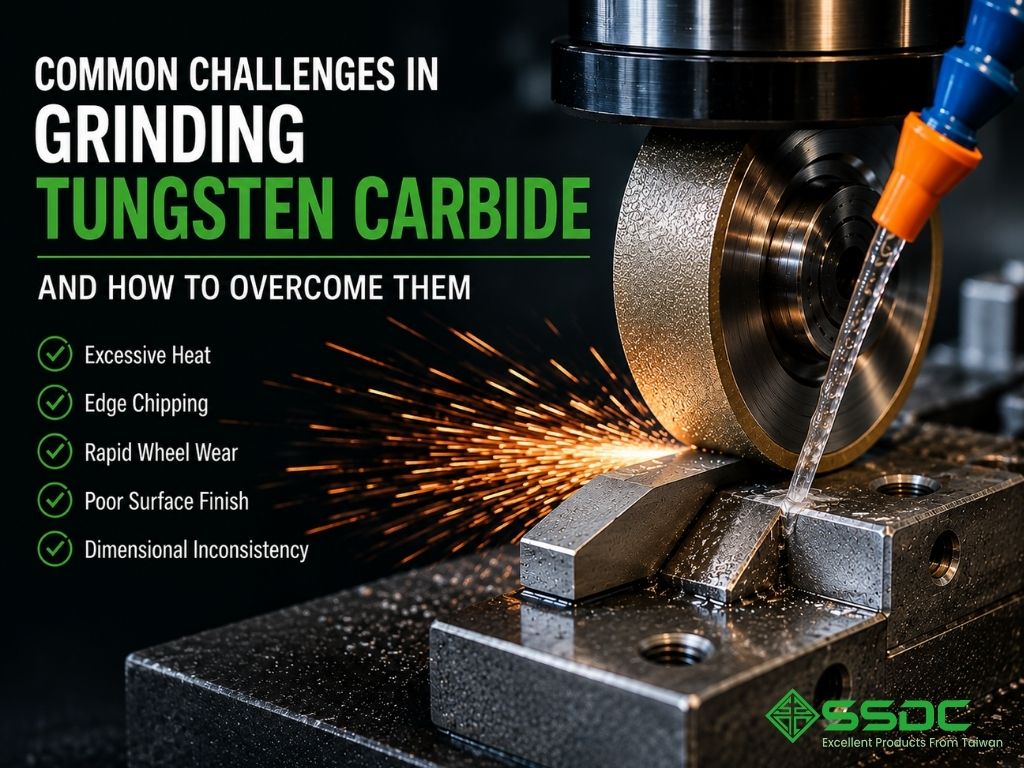
However, the same properties that make tungsten carbide highly durable also make it one of the most difficult materials to grind. Manufacturers often encounter problems such as excessive heat, edge chipping, poor surface finish, inconsistent dimensional accuracy, and rapid grinding wheel wear. These issues can affect machining quality, increase production costs, and reduce overall efficiency.
Understanding the causes of these challenges and selecting an appropriate grinding solution are essential for achieving stable and efficient carbide grinding. Manufacturers who would like to first understand the construction, characteristics, and common applications of diamond wheels can refer to Understanding Diamond Grinding Wheels.
Challenge 1: Excessive Grinding Heat
One of the most common problems when grinding tungsten carbide is excessive heat generation. Because tungsten carbide has high hardness, greater grinding forces may be produced when the wheel cannot remove material efficiently.
Instead of cutting cleanly, dull or unsuitable abrasive grains may rub against the workpiece surface. This additional friction increases heat at the grinding zone and can make the process more difficult to control.
Excessive grinding heat may contribute to:
- Surface burns
- Thermal stress
- Micro-cracks
- Changes in surface quality
- Reduced workpiece reliability
How to Overcome Excessive Grinding Heat
Reducing grinding resistance is one of the most effective ways to control heat. Diamond grinding wheels are widely used for tungsten carbide because diamond abrasives maintain sharp cutting edges and provide efficient material removal.
This sharp cutting action helps reduce unnecessary rubbing and supports more stable grinding conditions. Proper coolant delivery, suitable feed rates, and appropriate wheel speeds are also important for controlling temperature during the process.
Grinding parameters should be adjusted according to the workpiece geometry, required removal rate, and surface finish. Increasing the feed rate or grinding depth without considering the wheel specification may increase grinding force and heat rather than improve productivity.
Challenge 2: Edge Chipping and Surface Damage
Although tungsten carbide is extremely hard, it is also relatively brittle. This means that the workpiece may resist wear effectively but can still develop chips or cracks when subjected to excessive or unstable grinding forces.
Edge damage is particularly important when manufacturing cutting tools, inserts, punches, and other components with precision edges. Even a small defect may affect cutting performance or reduce the service life of the finished product.
Common forms of grinding-related damage include:
- Edge chipping
- Surface cracks
- Poor edge integrity
- Uneven surface finish
- Local material breakout
How to Reduce Chipping and Surface Damage
Selecting the proper abrasive specification is essential. Diamond grinding wheels provide efficient cutting action that can help reduce unnecessary mechanical stress on the workpiece.
Grit size must also be selected according to the required balance between material removal and surface quality. Coarser grits can support faster material removal but may leave a rougher finish, while finer grits are generally more suitable for finishing operations and delicate edges.
Stable workholding, controlled feed, and consistent coolant delivery also help reduce impact and vibration at the grinding zone. For a more detailed explanation of why diamond abrasives are commonly selected for carbide, read Why Diamond Grinding Wheels Are Preferred for Grinding Tungsten Carbide.
Challenge 3: Rapid Grinding Wheel Wear
Grinding tungsten carbide places significant demands on the grinding wheel. When an unsuitable abrasive or wheel specification is used, the wheel may lose cutting ability quickly.
As the wheel becomes less effective, grinding resistance increases and the process may require longer cycle times or more frequent wheel replacement. This can affect both machining efficiency and operating cost.
Rapid wheel wear may lead to:
- Reduced grinding efficiency
- Frequent wheel replacement
- Increased production downtime
- Higher tooling consumption
- Less consistent grinding results
How to Improve Usable Wheel Life
Diamond grinding wheels are well suited for tungsten carbide because diamond is harder than the workpiece material and can maintain effective cutting performance under demanding grinding conditions.
The wheel specification should match the carbide grade, grinding operation, desired finish, and material removal requirement. Using a wheel designed only for general-purpose grinding may result in unnecessary wear or unstable performance.
Electroplated diamond grinding wheels may provide stable abrasive exposure and sharp cutting characteristics in suitable applications. Because the abrasive layer is exposed, electroplated wheels generally do not require dressing during their usable life.
Challenge 4: Poor or Inconsistent Surface Finish
Surface quality is an important requirement for tungsten carbide components, especially when the finished surface affects cutting performance, friction, assembly, or dimensional inspection.
Poor grinding conditions may create rough surfaces, scratches, uneven grinding marks, or inconsistent surface roughness between workpieces.
Several factors can influence the final surface condition:
- Abrasive type
- Grit size
- Grinding force
- Wheel condition
- Machine vibration
- Coolant delivery
How to Improve Surface Finish
A finer abrasive grit is generally selected when a smoother surface is required. However, choosing the finest available grit does not automatically guarantee the best result. The grit must still match the grinding operation and material removal requirement.
Wheel stability and abrasive exposure also affect surface consistency. A wheel that cuts evenly is more likely to produce a uniform finish across multiple workpieces.
Manufacturers should also review spindle condition, workholding, feed rate, and coolant application. Surface problems are not always caused by the grinding wheel alone, so the entire grinding system should be evaluated before changing wheel specifications.
Challenge 5: Maintaining Dimensional Consistency
Many tungsten carbide components require controlled dimensions and repeatable geometry throughout production. This is especially important for cutting tools, dies, punches, inserts, and precision wear components.
Dimensional variation may occur when grinding forces change, the wheel wears unevenly, vibration develops, or machine conditions are unstable. If these factors are not controlled, the finished dimensions may gradually drift during production.
Components that commonly require consistent grinding results include:
- End mills
- Drills
- Reamers
- Carbide inserts
- Punches and dies
- Precision wear components
How to Maintain More Stable Grinding Results
Selecting a grinding wheel that matches the tungsten carbide application can help maintain more stable cutting characteristics. Consistent abrasive exposure and suitable wheel geometry support repeatable material removal.
The grinding machine should also be inspected regularly. Spindle runout, fixture condition, wheel mounting, and machine rigidity can all influence the finished dimensions.
When a standard wheel does not match the workpiece geometry or grinding requirements, a customized specification may be considered. The article Common Problems Solved by Customized Grinding Wheels in Industrial Applications explains how application-specific wheel selection can address common industrial grinding problems.
Common Tungsten Carbide Grinding Challenges and Solutions
| Grinding Challenge | Possible Causes | Recommended Actions |
|---|---|---|
| Excessive grinding heat | High grinding resistance, unsuitable parameters, or insufficient coolant | Use a suitable diamond wheel, review feed and speed, and improve coolant delivery |
| Edge chipping | Excessive force, coarse grit, unstable workholding, or vibration | Select an appropriate grit size and maintain stable grinding conditions |
| Rapid wheel wear | Unsuitable abrasive or wheel specification | Match the diamond wheel specification to the carbide grade and grinding operation |
| Poor surface finish | Incorrect grit, wheel vibration, or unstable grinding parameters | Review grit size, wheel condition, workholding, feed, and coolant |
| Dimensional variation | Wheel wear, spindle runout, fixture movement, or inconsistent cutting behavior | Inspect the complete grinding system and select a suitable wheel design |
Why Diamond Grinding Wheels Are Commonly Used for Tungsten Carbide
Diamond is the hardest abrasive material and is widely used for grinding tungsten carbide. Its hardness allows the abrasive grains to remove carbide material efficiently while maintaining sharp cutting characteristics.
Compared with conventional abrasives, suitable diamond grinding wheels can provide:
- Efficient material removal
- Lower grinding resistance
- Reduced unnecessary heat generation
- More consistent surface quality
- Stable performance in suitable grinding applications
Diamond grinding wheels are available in different structures and specifications. The appropriate choice depends on the carbide grade, grinding operation, desired finish, workpiece geometry, and production requirements.
Factors to Consider When Selecting a Grinding Wheel
There is no single diamond grinding wheel specification that is suitable for every tungsten carbide application. Manufacturers should evaluate the complete grinding requirement before selecting a wheel.
| Selection Factor | Points to Consider |
|---|---|
| Carbide grade | Different carbide compositions and hardness levels may require different wheel specifications |
| Grinding operation | Consider whether the process involves surface, cylindrical, internal, profile, or tool grinding |
| Material removal rate | Rough grinding and finishing operations require different balances between removal efficiency and surface quality |
| Surface finish | Finer grit is generally considered when a smoother finish is required |
| Workpiece geometry | The wheel shape and dimensions should match the component and grinding area |
| Machine conditions | Review spindle condition, rigidity, available speed, coolant, and mounting requirements |
Typical Applications for Grinding Tungsten Carbide
Diamond grinding wheels are commonly used in the production, finishing, and reconditioning of tungsten carbide products.
Typical applications include:
- Carbide end mills
- Carbide drills
- Reamers
- Cutting inserts
- Punches and dies
- Wear-resistant components
- Precision tooling parts
Each application has different requirements for material removal, edge quality, profile retention, and surface finish. The grinding wheel should therefore be selected according to the actual carbide component and manufacturing process.
SSDC Grinding Solutions for Tungsten Carbide Applications
Sea Shore Diamond Industrial Co., Ltd. (SSDC) provides electroplated diamond and CBN grinding tools for a range of industrial grinding applications.
For tungsten carbide grinding, diamond abrasive is generally selected because of its hardness and cutting characteristics. SSDC offers various grinding wheel specifications to support different workpiece shapes and grinding requirements.
Relevant product features include:
- Electroplated diamond technology
- Diamond and CBN abrasive options for different materials
- Various wheel shapes and specifications
- Grinding solutions for different industrial applications
- Stable abrasive exposure during the usable life of electroplated wheels
By reviewing the workpiece material, geometry, grinding operation, and required finish, manufacturers can identify a more suitable grinding wheel for their application.
FAQ: Grinding Tungsten Carbide
Q1: Why is tungsten carbide difficult to grind?
Tungsten carbide combines very high hardness with relatively brittle characteristics. Efficient grinding therefore requires a suitable abrasive and stable process conditions to remove material without creating excessive heat or edge damage.
Q2: Why are diamond grinding wheels recommended for tungsten carbide?
Diamond is harder than tungsten carbide and provides efficient cutting performance. This makes diamond grinding wheels suitable for many precision carbide grinding applications.
Q3: Can grinding heat damage tungsten carbide?
Excessive grinding heat may contribute to thermal stress, surface damage, or micro-cracks. Suitable wheel selection, controlled grinding parameters, and proper coolant application can help reduce these risks.
Q4: How can edge chipping be reduced when grinding carbide?
Edge chipping can be reduced by selecting an appropriate diamond wheel and grit size, avoiding excessive feed or grinding force, maintaining stable workholding, and using suitable coolant delivery.
Q5: Are electroplated diamond grinding wheels suitable for carbide grinding?
Electroplated diamond grinding wheels are used in various carbide grinding applications because they provide exposed abrasive grains, sharp cutting characteristics, and stable wheel geometry. Their suitability should be evaluated according to the specific grinding operation.
Q6: Should coarse or fine grit be used for tungsten carbide?
Coarser grit is generally used when a higher material removal rate is required, while finer grit is considered for smoother surface finishes and finishing operations. The final selection should reflect both productivity and quality requirements.
Conclusion
Grinding tungsten carbide presents several challenges because of the material's high hardness and brittle nature. Excessive heat, edge chipping, rapid wheel wear, poor surface finish, and dimensional variation can all occur when the wheel specification or grinding conditions do not match the application.
Using a suitable diamond grinding wheel, together with stable machine conditions, appropriate parameters, and effective coolant delivery, can help improve grinding consistency and workpiece quality.
Sea Shore Diamond Industrial Co., Ltd. (SSDC) provides electroplated diamond grinding tools for different industrial applications. Manufacturers can evaluate the carbide grade, component geometry, grinding operation, and surface requirements to identify a wheel specification suitable for their production needs.