
Recent Articles
Why Diamond Grinding Wheels Are Preferred for Grinding Tungsten Carbide
2026-06-17
Introduction
Tungsten carbide is one of the most widely used materials in modern manufacturing due to its exceptional hardness, wear resistance, and ability to maintain dimensional stability under demanding operating conditions. It is commonly used in cutting tools, molds, dies, wear parts, and precision components across industries such as automotive, aerospace, electronics, and tooling.
However, the same properties that make tungsten carbide valuable also make it difficult to machine. Conventional abrasives often struggle to remove material efficiently while maintaining dimensional accuracy and surface quality. Excessive grinding force, heat generation, and wheel wear can all affect productivity and part quality.
For this reason, diamond grinding wheels have become the preferred solution for grinding tungsten carbide. Their superior hardness and cutting performance allow manufacturers to achieve the precision and consistency required for modern industrial applications.
Understanding the Challenges of Grinding Tungsten Carbide
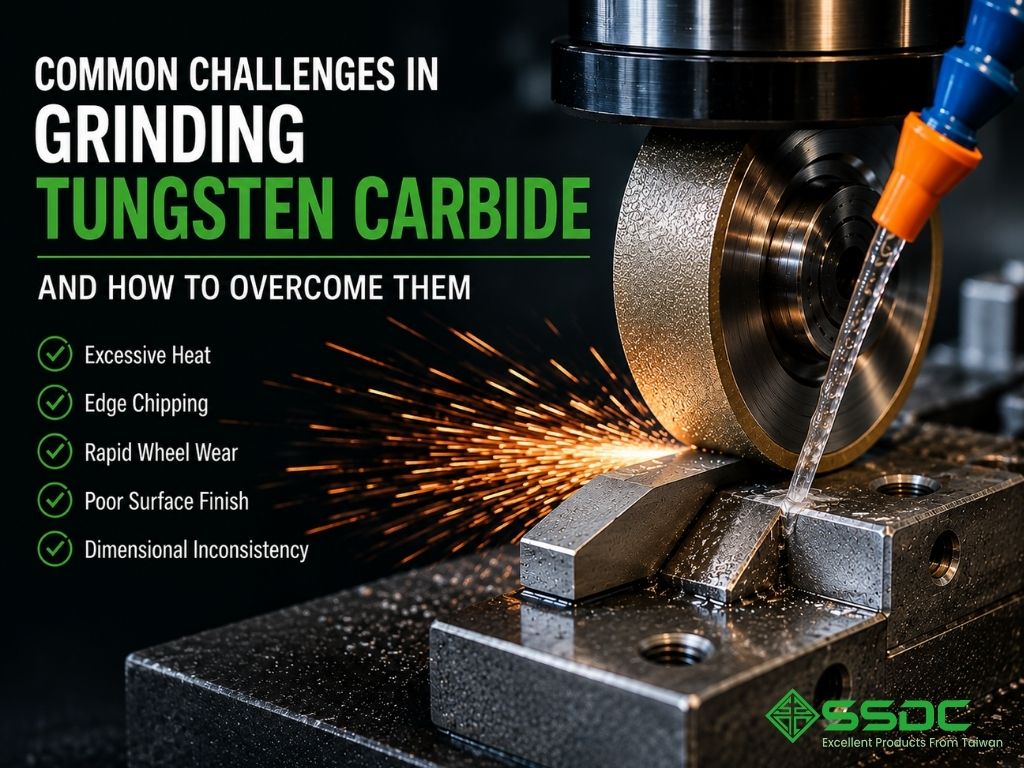
Tungsten carbide is significantly harder than most steels and engineering alloys. While this hardness provides excellent wear resistance, it also creates unique grinding challenges.
One of the most common issues is excessive grinding force. When the abrasive is unable to cut efficiently, it tends to rub against the workpiece, generating additional heat and reducing grinding performance. Over time, this can affect both the grinding wheel and the workpiece.
Another challenge is maintaining surface integrity. Tungsten carbide is a relatively brittle material, meaning that improper grinding conditions can lead to edge chipping, micro-cracks, or surface damage. These defects may reduce the performance and service life of finished components, particularly cutting tools and precision wear parts.
Manufacturers also need to maintain tight dimensional tolerances. As grinding wheels wear, maintaining consistent accuracy becomes increasingly difficult if the abrasive cannot sustain effective cutting action.
These challenges make abrasive selection one of the most important factors in tungsten carbide grinding operations.
Why Diamond Is the Ideal Abrasive for Tungsten Carbide
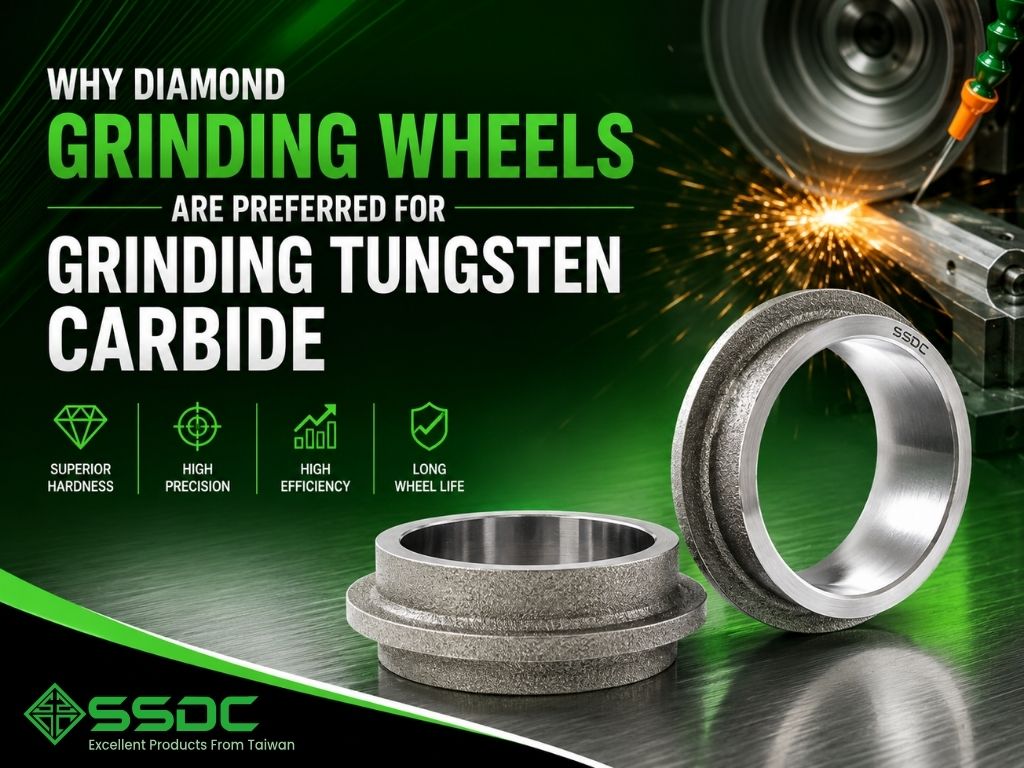
Diamond is the hardest known material and offers significant advantages when grinding tungsten carbide.
Because diamond is substantially harder than tungsten carbide, it can efficiently remove material while maintaining sharp cutting edges. Instead of rubbing against the workpiece surface, diamond abrasives perform a true cutting action that improves grinding efficiency and reduces unnecessary heat generation.
This characteristic helps manufacturers achieve:
-
Lower grinding forces
-
Improved material removal efficiency
-
Better dimensional consistency
-
Reduced heat generation
-
Longer wheel service life
Compared to conventional abrasives, diamond grinding wheels can maintain stable cutting performance over longer production runs. This makes them particularly suitable for applications where consistent quality and repeatability are critical.
As a result, diamond grinding wheels have become the industry standard for grinding tungsten carbide components.
Improved Surface Finish and Edge Quality
Surface quality is a key consideration when grinding tungsten carbide components.
In applications such as cutting tools, punches, dies, and wear-resistant parts, the final surface condition directly affects product performance. A rough or damaged surface may increase friction, reduce tool life, or negatively impact dimensional accuracy.
Poor grinding conditions can cause:
-
Surface burns
-
Edge chipping
-
Micro-cracks
-
Inconsistent surface roughness
Diamond grinding wheels help minimize these issues by providing efficient cutting action and stable grinding performance. Because the abrasive remains sharp, the wheel can remove material more effectively while reducing mechanical stress on the workpiece.
The result is improved surface finish and better edge integrity. This is particularly important for carbide cutting tools, where even minor edge defects can affect cutting performance and service life.
For manufacturers producing high-value tungsten carbide components, maintaining consistent surface quality is often one of the primary reasons for choosing diamond grinding wheels.
Higher Grinding Efficiency and Productivity
Grinding tungsten carbide can be a time-consuming process if the grinding wheel is not optimized for the application.
Traditional abrasives often experience faster wear when machining hard materials. As wheel performance decreases, grinding times may increase and more frequent wheel maintenance may be required.
Diamond grinding wheels help improve productivity by maintaining effective cutting performance throughout the grinding process.
Key benefits include:
-
Faster material removal
-
Reduced grinding time
-
Lower grinding forces
-
Improved process consistency
-
Reduced wheel replacement frequency
For production environments, these advantages can translate into lower operating costs and improved throughput.
By reducing the need for frequent wheel changes and minimizing process interruptions, manufacturers can achieve more efficient use of machine time and labor resources.
The Advantages of Electroplated Diamond Grinding Wheels
Among the various types of diamond grinding wheels available, electroplated diamond grinding wheels offer unique advantages for specific tungsten carbide grinding applications.
Electroplated wheels use a single layer of diamond abrasive that is permanently bonded to the wheel surface. Unlike conventional multi-layer grinding wheels, the diamond particles remain fully exposed throughout the wheel's service life.
This design provides several performance benefits.
Why High Grain Protrusion Matters
One of the key characteristics of electroplated grinding wheels is high grain protrusion.
Because the abrasive particles extend further from the wheel surface, they can engage the workpiece more effectively. This allows the wheel to cut efficiently while reducing grinding resistance.
Benefits include:
-
Improved cutting action
-
Reduced heat generation
-
Better chip evacuation
-
More stable grinding performance
These characteristics are especially useful when grinding hard materials such as tungsten carbide.
Why No Dressing Improves Productivity
Conventional grinding wheels often require periodic dressing to restore wheel sharpness and geometry.
Electroplated grinding wheels typically do not require dressing because the abrasive layer remains exposed and maintains its cutting characteristics throughout the wheel's usable life.
This can help manufacturers:
-
Reduce machine downtime
-
Simplify production processes
-
Improve operational efficiency
-
Maintain consistent grinding performance
For many precision grinding applications, eliminating dressing operations can contribute to overall productivity improvements.
How to Select the Right Diamond Grinding Wheel for Tungsten Carbide
Selecting the right grinding wheel depends on several factors, including the workpiece material, grinding operation, and desired surface quality.
| Factor | Consideration |
|---|---|
| Tungsten carbide grade | Different grades may require different abrasive specifications |
| Grinding operation | OD, ID, profile, or tool grinding |
| Surface finish requirement | Fine grit for smoother surfaces, coarse grit for higher removal rates |
| Production volume | Prototype production and mass production may have different priorities |
| Component geometry | Wheel shape and profile should match the application |
Working with an experienced grinding wheel supplier can help ensure that the wheel specification matches the grinding requirements and production goals.
Typical Applications for Grinding Tungsten Carbide
Diamond grinding wheels are widely used in the manufacturing and reconditioning of tungsten carbide components.
Common applications include:
-
End mills
-
Drills
-
Reamers
-
Inserts
-
Punches and dies
-
Wear-resistant components
-
Precision tooling parts
These applications require high levels of accuracy, consistency, and surface quality, making diamond grinding wheels a preferred choice for manufacturers worldwide.
Why Manufacturers Choose SSDC Diamond Grinding Wheels
Sea Shore Diamond Industrial Co., Ltd. (SSDC) specializes in electroplated diamond and CBN grinding solutions for industrial applications.
Our diamond grinding wheels are designed to support the grinding of hard and difficult-to-machine materials, including tungsten carbide.
Key features include:
-
Electroplated diamond technology
-
Diamond and CBN abrasive options
-
Stable grinding performance
-
Various wheel specifications
-
Solutions for different grinding applications
By combining practical application experience with electroplated grinding technology, SSDC provides grinding solutions that help manufacturers improve process consistency and product quality.
FAQ: Grinding Tungsten Carbide
Q1: Why is tungsten carbide difficult to grind?
Tungsten carbide has extremely high hardness and wear resistance, making material removal more challenging than many conventional materials.
Q2: Why are diamond grinding wheels preferred for tungsten carbide?
Diamond is harder than tungsten carbide and provides efficient cutting performance, making it well suited for precision grinding applications.
Q3: Can CBN grinding wheels be used for tungsten carbide?
CBN grinding wheels are typically used for hardened steels. Diamond grinding wheels are generally preferred for tungsten carbide applications.
Q4: Are electroplated diamond grinding wheels suitable for carbide tool grinding?
Yes. Electroplated diamond grinding wheels are commonly used for carbide tool manufacturing and regrinding because of their sharp cutting characteristics and stable grinding performance.
Conclusion
Grinding tungsten carbide requires abrasive solutions capable of handling extreme hardness while maintaining precision and efficiency.
Diamond grinding wheels have become the preferred choice because they offer efficient cutting performance, improved surface quality, and consistent grinding results. Their ability to reduce grinding resistance and maintain stable cutting action makes them particularly suitable for demanding carbide grinding applications.
For manufacturers seeking reliable grinding solutions for tungsten carbide, SSDC provides electroplated diamond grinding wheels designed to support precision manufacturing requirements and a wide range of industrial grinding applications.