
Recent Articles

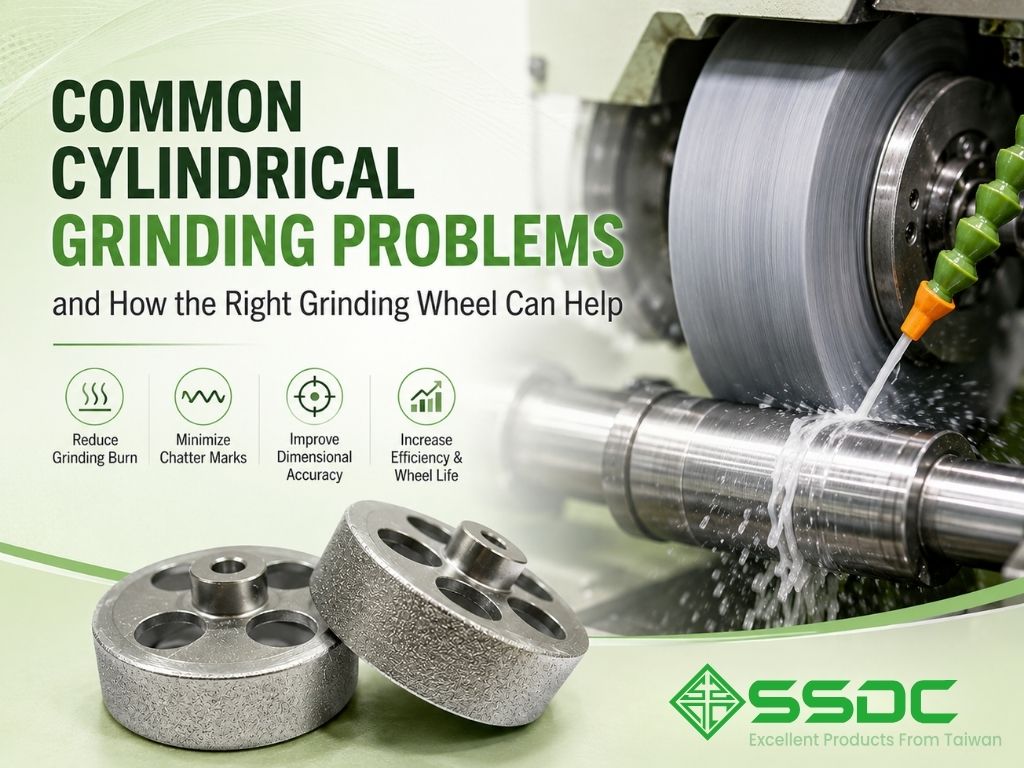
Common Cylindrical Grinding Problems and How the Right Grinding Wheel Can Help
2026-08-21
Introduction
Cylindrical grinding is widely used to achieve accurate dimensions and controlled surface finishes on round components such as shafts, pins, rollers, and other precision parts. Although the basic process may appear straightforward, maintaining stable grinding results can become difficult when workpiece materials, wheel specifications, machine conditions, and operating parameters are not properly matched.
Common cylindrical grinding problems include grinding burn, chatter marks, poor surface finish, dimensional variation, excessive wheel wear, and reduced material removal efficiency. These issues can affect product quality and increase the time required for inspection, adjustment, or rework.
The grinding wheel is an important part of this process, but it is not the only factor. Machine rigidity, wheel mounting, coolant delivery, dressing conditions, feed rate, and workpiece setup can also influence the final result.
Understanding how these factors interact—and selecting a suitable cylindrical grinding wheel—can help manufacturers achieve more consistent grinding performance.
Problem 1: Grinding Burn and Excessive Heat
Excessive heat is one of the most common problems encountered during cylindrical grinding. The grinding zone can generate significant heat when abrasive grains do not remove material efficiently or when grinding conditions create excessive friction.
Grinding burn may appear as discoloration on the workpiece surface, but thermal effects can extend beyond visible marks. Depending on the workpiece material and severity of the process conditions, excessive heat may affect surface integrity and finished-part quality.
Several conditions can contribute to excessive grinding heat:
- An unsuitable grinding wheel specification
- Dull or loaded abrasive grains
- Excessive feed or depth of cut
- Insufficient coolant delivery
- Incorrect dressing conditions
- Inappropriate wheel or workpiece speed
How the Right Grinding Wheel Can Help
A suitable cylindrical grinding wheel should provide effective cutting action for the workpiece material and required operation. When abrasive grains cut efficiently instead of rubbing against the surface, grinding resistance and unnecessary heat generation can be reduced.
Wheel specification should therefore be considered together with feed, speed, coolant, and dressing conditions rather than evaluated independently.
If burn marks continue after changing the wheel, manufacturers should also inspect coolant delivery, dressing conditions, machine setup, and operating parameters before assuming that the wheel itself is the only cause.
Problem 2: Chatter Marks and Vibration
Chatter is another common cylindrical grinding problem. It often appears as regular lines, waves, or repeating patterns on the ground surface.
Vibration may originate from several parts of the grinding system, including the grinding wheel, spindle, workpiece, fixture, or machine structure. Because cylindrical grinding requires continuous contact between the rotating wheel and rotating workpiece, even relatively small instability can become visible on the finished surface.
Possible causes include:
- Poor wheel balance
- Incorrect wheel mounting
- Spindle vibration or runout
- Insufficient workpiece support
- Machine rigidity issues
- Unsuitable grinding parameters
- Wheel condition
How the Right Grinding Wheel Can Help
Selecting a wheel with appropriate dimensions and specifications is one part of maintaining a stable grinding process. A wheel that matches the application can provide more consistent cutting action and help avoid unnecessary changes in grinding force.
However, changing the grinding wheel will not correct vibration caused by worn spindle components, incorrect mounting, workpiece deflection, or an unstable machine.
When chatter occurs, the entire grinding system should be inspected. Wheel balance and condition can be checked together with spindle condition, workholding, machine rigidity, and operating parameters to identify the actual source of vibration.
Problem 3: Poor or Inconsistent Surface Finish
Surface finish is one of the most important quality requirements in cylindrical grinding. Depending on the component, the ground surface may affect fit, sealing, friction, fatigue performance, or subsequent manufacturing operations.
Common surface finish problems include:
- Scratches
- Uneven grinding marks
- Rough surfaces
- Chatter patterns
- Inconsistent surface roughness between parts
A common mistake is to assume that simply using a finer grit will always produce a better surface. In practice, surface quality depends on the complete grinding process.
How the Right Grinding Wheel Can Help
Abrasive type, grit size, wheel structure, and other wheel characteristics influence how material is removed from the workpiece.
Coarser abrasive grains are generally associated with higher material removal capability, while finer grits are commonly considered when a smoother finish is required. The correct choice depends on whether the operation is rough grinding, semi-finishing, or finishing.
A grit that is too fine for a heavy stock-removal operation may increase grinding resistance or loading rather than improve the process.
For this reason, surface finish requirements should be evaluated together with material removal requirements, workpiece material, grinding conditions, and wheel specification.
Problem 4: Dimensional Variation and Difficulty Holding Tolerances
One of the main reasons manufacturers use cylindrical grinding is to achieve controlled outside diameters and accurate round components. When dimensions begin to vary during production, the cause needs to be identified quickly.
Dimensional variation can result from:
- Grinding wheel wear
- Thermal changes
- Workpiece deflection
- Spindle or fixture problems
- Inconsistent grinding forces
- Machine condition
- Process parameter changes
If the wheel loses effective cutting ability, grinding forces may change and influence process consistency. However, dimensional problems should not automatically be attributed to the wheel.
How the Right Grinding Wheel Can Help
A suitable cylindrical grinding wheel can provide more stable material removal for the intended application. Matching the wheel to the workpiece material and grinding requirement helps establish a more predictable grinding process.
Operators should also monitor wheel condition and process behavior throughout production.
When dimensional variation occurs, checking wheel condition together with workholding, spindle runout, machine temperature, coolant, and process settings provides a more complete diagnosis than changing the wheel alone.
This system-level approach is especially important when grinding components that require repeatable dimensions across larger production quantities.
Problem 5: Excessive Grinding Wheel Wear
Grinding wheel wear is unavoidable, but unusually rapid wear can increase tooling consumption, interrupt production, and make process control more difficult.
Wheel life depends on multiple factors, including the abrasive, bond system, workpiece material, grinding parameters, dressing frequency, and required material removal rate.
If the selected wheel is not suitable for the workpiece or grinding operation, manufacturers may experience:
- Rapid loss of wheel geometry
- More frequent dressing
- Increased wheel consumption
- Unstable grinding performance
- Higher tooling costs
How the Right Grinding Wheel Can Help
The appropriate wheel should balance cutting ability, wheel retention, and the required finish.
Selecting a wheel only because it is harder or expected to last longer is not always the best approach. A wheel that retains abrasive grains too strongly may become dull under unsuitable conditions, while a specification that releases abrasive too easily may wear unnecessarily fast.
The objective is therefore not simply to maximize wheel life, but to select a specification that provides an appropriate balance between grinding performance, surface requirements, and usable wheel life.
Problem 6: Wheel Loading and Reduced Cutting Efficiency
Wheel loading occurs when workpiece material or grinding debris accumulates around the abrasive surface and reduces the wheel's ability to cut effectively.
As loading increases, operators may notice:
- Higher grinding forces
- Increased heat
- Reduced material removal
- Poorer surface finish
- More frequent dressing requirements
Loading can be influenced by the workpiece material, wheel specification, coolant conditions, dressing, and grinding parameters.
How the Right Grinding Wheel Can Help
The grinding wheel should be selected according to the material being processed and the type of cylindrical grinding operation.
A wheel specification suitable for one material may behave differently when used on another. Abrasive characteristics and wheel structure therefore need to match the actual application.
Coolant delivery and dressing conditions should also be reviewed when loading occurs. In many cases, improving wheel selection without correcting unsuitable process conditions will not completely eliminate the problem.
Quick Guide to Common Cylindrical Grinding Problems
| Grinding Problem | Possible Causes | What to Check |
|---|---|---|
| Grinding burn | High grinding resistance, dull wheel, insufficient coolant | Wheel specification, dressing, feed, speed, coolant |
| Chatter marks | Vibration, poor balance, spindle or setup issues | Wheel balance, mounting, spindle, workholding |
| Poor surface finish | Incorrect grit, vibration, wheel condition | Grit size, wheel specification, machine condition |
| Dimensional variation | Wheel wear, thermal effects, workpiece movement | Wheel condition, spindle, fixture, process stability |
| Rapid wheel wear | Unsuitable wheel specification or grinding conditions | Abrasive, bond, parameters, dressing |
| Wheel loading | Material accumulation or unsuitable wheel/process conditions | Wheel specification, dressing, coolant, parameters |
The table can be used as a starting point for troubleshooting, but several causes may occur at the same time. Effective troubleshooting should consider the complete grinding system rather than relying on a single adjustment.
How to Select a Cylindrical Grinding Wheel for More Stable Results
There is no single cylindrical grinding wheel that is ideal for every workpiece or grinding operation.
Before selecting a wheel, manufacturers should consider several factors.
1. Workpiece Material
The hardness and characteristics of the workpiece affect abrasive selection and grinding behavior. Different materials require different grinding approaches.
2. Grinding Stage
Rough grinding prioritizes material removal, while finish grinding places greater emphasis on surface quality and dimensional control. These operations may require different wheel specifications.
3. Required Surface Finish
The required surface roughness influences grit selection. Finer abrasive grains are generally considered for finishing, while coarser grains may be suitable for higher stock removal.
4. Workpiece Geometry
Diameter, grinding length, shoulders, profiles, and other geometric features influence the appropriate wheel shape and dimensions.
5. Machine and Process Conditions
Wheel speed, workpiece speed, feed, coolant, dressing conditions, machine rigidity, and spindle condition all influence grinding performance.
Considering these factors together provides a more reliable basis for wheel selection than focusing on a single specification.
When Should You Consider a Different Grinding Wheel?
Not every grinding problem requires a new wheel. If the process previously produced stable results and suddenly develops chatter, burn, or dimensional variation, machine condition, coolant delivery, dressing, wheel mounting, and workholding should be checked first.
A different wheel specification may be worth considering when:
- The current wheel repeatedly generates excessive grinding resistance
- Required surface quality cannot be achieved consistently
- Wheel wear is unsuitable for the production requirement
- The workpiece material has changed
- Roughing and finishing requirements have changed
- The wheel shape or dimensions do not suit the grinding area
The objective should be to identify the source of the problem and then determine whether wheel selection is part of the solution.
SSDC Cylindrical Grinding Wheel Solutions
Sea Shore Diamond Industrial Co., Ltd. (SSDC) provides grinding tools for a range of precision industrial applications.
For cylindrical grinding applications, SSDC offers Cylindrical Grinding Wheels designed for external cylindrical grinding. Different wheel specifications can be considered according to the workpiece and grinding requirements.
When evaluating a cylindrical grinding wheel, information such as the workpiece material, required dimensions, grinding operation, and desired surface quality can help determine a suitable solution.
Rather than treating the grinding wheel as an isolated component, manufacturers should evaluate how it works together with the machine, workpiece, coolant, dressing, and operating conditions.
FAQ: Cylindrical Grinding Wheel Problems
Q1: What causes burn marks in cylindrical grinding?
Grinding burn can occur when excessive heat develops at the grinding zone. Possible causes include high grinding resistance, unsuitable wheel conditions, excessive feed, insufficient coolant, or incorrect dressing. The wheel and process conditions should be evaluated together.
Q2: Why does a cylindrical grinding wheel leave chatter marks?
Chatter may be caused by wheel imbalance, mounting problems, spindle vibration, insufficient workpiece support, machine rigidity, or unsuitable grinding parameters. The source of vibration should be identified before changing the wheel specification.
Q3: Does a finer grit always improve surface finish?
No. Finer grit can support smoother finishing, but using a grit that is too fine for the material removal requirement may increase grinding resistance or wheel loading. Grit selection should balance finish quality and grinding efficiency.
Q4: What information is important when selecting a cylindrical grinding wheel?
Important factors include the workpiece material, grinding operation, required surface finish, component geometry, material removal requirement, and relevant machine and process conditions.
Conclusion: Solve the Process, Not Just the Symptom
Common cylindrical grinding problems such as burn, chatter, poor surface finish, dimensional variation, wheel wear, and loading rarely have only one possible cause.
The cylindrical grinding wheel plays an important role because its abrasive characteristics and specifications directly influence material removal and grinding behavior. However, machine condition, wheel mounting, dressing, coolant, workholding, and operating parameters must also be considered.
Selecting the right grinding wheel therefore begins with understanding the actual grinding problem rather than simply replacing the existing wheel with a different specification.
For manufacturers evaluating cylindrical grinding wheels for precision grinding applications, Sea Shore Diamond Industrial Co., Ltd. (SSDC) provides grinding tool solutions for different industrial grinding requirements.