
Recent Articles
Why Do Grinding Discs Wear Out Too Quickly? Common Causes and Solutions
2026-09-15
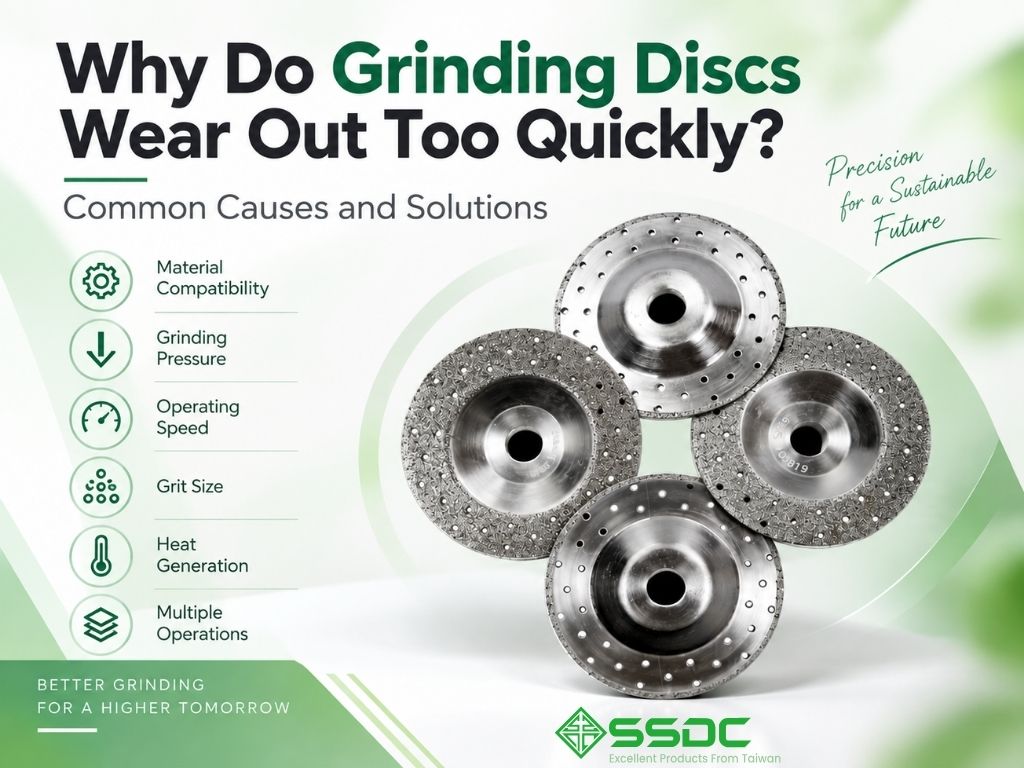
Grinding discs are consumable tools, so gradual wear during operation is normal. However, when a grinding disc wears much faster than expected, manufacturers may face more frequent tool changes, higher consumable costs, longer downtime, and inconsistent grinding results.
The problem is not always the grinding disc itself. Rapid wear can also result from an unsuitable abrasive specification, excessive grinding pressure, incorrect operating speed, poor matching between the disc and workpiece material, or demanding material-removal requirements.
Instead of simply replacing grinding discs more frequently, manufacturers should identify why the disc is wearing quickly and whether its specification matches the actual grinding application.
This article examines six common causes of premature grinding disc wear and what manufacturers should evaluate before changing their grinding tools.
Table of Contents
- 1. The Grinding Disc Does Not Match the Workpiece Material
- 2. Excessive Grinding Pressure Is Accelerating Disc Wear
- 3. Operating Speed Does Not Match the Grinding Disc or Application
- 4. The Grit Size Does Not Match the Grinding Requirement
- 5. Heat Is Reducing Grinding Stability
- 6. One Grinding Disc Is Being Used for Too Many Operations
- Quick Troubleshooting Guide
- How to Reduce Grinding Disc Consumption Without Sacrificing Quality
- When Should You Consider a Different Grinding Disc?
- SSDC Grinding Disc Solutions
- FAQ: Grinding Disc Wear and Selection
1. The Grinding Disc Does Not Match the Workpiece Material
One of the first factors to check is whether the grinding disc is suitable for the material being processed.
Different materials have different hardness, brittleness, thermal behavior, and grinding characteristics. A disc that performs effectively on one material may wear significantly faster or provide poor cutting performance on another.
For example, grinding hard and difficult-to-machine materials places different demands on the abrasive than grinding relatively softer materials.
How to Improve It
Start by matching the abrasive to the workpiece material rather than selecting a grinding disc based only on dimensions or price.
Diamond abrasives are commonly used for hard and brittle materials such as:
- Tungsten carbide
- Ceramics
- Glass
- Stone
- Other suitable hard materials
The correct abrasive selection helps maintain effective material removal and reduces unnecessary tool consumption.
For applications involving tungsten carbide, you can also read Why Diamond Grinding Wheels Are Preferred for Grinding Tungsten Carbide to understand why abrasive selection is particularly important when grinding hard materials.
The key question is therefore not simply "How long should this grinding disc last?" but "Is this grinding disc designed for the material being processed?"
2. Excessive Grinding Pressure Is Accelerating Disc Wear
When material removal seems too slow, operators may instinctively apply more pressure. However, greater pressure does not always result in proportionally faster grinding.
Excessive grinding force can increase friction and heat at the contact area. Depending on the grinding disc and application, this may accelerate abrasive wear and make grinding performance less stable.
Possible signs include:
- Rapid loss of cutting performance
- Excessive heat
- Increasing grinding force
- Unstable surface quality
- Shorter disc life
How to Improve It
Grinding pressure should allow the abrasive grains to perform the cutting rather than forcing the disc into the workpiece.
If significantly greater pressure is constantly required to maintain material removal, the problem may be related to the disc specification, abrasive condition, operating parameters, or material compatibility.
Increasing pressure should not be the first response to poor grinding efficiency. Instead, check whether the grinding disc and process conditions still match the application.
3. Operating Speed Does Not Match the Grinding Disc or Application
Grinding disc performance is closely related to operating speed.
If the speed is not appropriate for the disc specification or grinding process, the interaction between the abrasive and workpiece changes. This can affect material removal, heat generation, surface quality, and disc wear.
Operating outside the intended conditions can also create safety concerns.
How to Improve It
Before operation, manufacturers should confirm:
- Grinding disc specifications
- Recommended operating conditions
- Machine spindle speed
- Disc diameter
- Application requirements
The grinding disc should always be operated within its specified limits.
If disc life changes significantly after moving the same process to another machine, operating speed and machine conditions should be among the first factors checked.
4. The Grit Size Does Not Match the Grinding Requirement
Grit size influences both material removal and finished surface quality.
A common mistake is to select a finer grit simply because a smoother finish is desired. While finer abrasive grains are often used for finishing, they may not be the most efficient option when substantial material removal is required.
Likewise, a coarse grit selected only for faster grinding may not provide the surface quality required by the finished component.
How to Improve It
Grinding disc selection should balance material removal requirements with the desired surface finish.
| Grinding Requirement | General Consideration |
|---|---|
| Higher material removal | A relatively coarser grit may be considered |
| Fine finishing | A finer grit may be more appropriate |
| Roughing followed by finishing | Different grinding stages may require different specifications |
| Precision grinding | Balance surface finish, material removal, and process stability |
Rather than asking which grit lasts the longest, manufacturers should determine which grit provides the most appropriate balance between material removal rate, surface finish, and tool consumption.
For a broader understanding of how grinding disc selection influences cutting and finishing performance, see Grinding Discs Explained: Cut Faster, Finish Smoother.
5. Heat Is Reducing Grinding Stability
Heat is generated naturally during grinding because abrasive grains continuously interact with the workpiece. However, excessive heat can indicate that the grinding process is becoming inefficient.
When the abrasive is no longer cutting effectively, more energy may be converted into friction rather than material removal. This can affect both the workpiece and the grinding disc.
Possible symptoms include:
- Workpiece discoloration
- Reduced cutting efficiency
- Increasing grinding force
- Surface quality changes
- Accelerated abrasive wear
How to Improve It
Heat should be treated as a process signal rather than an isolated problem.
When excessive heat occurs, check:
- Grinding pressure
- Operating speed
- Grinding disc specification
- Abrasive condition
- Material compatibility
- Cooling conditions, where applicable
If the grinding process requires progressively more force while generating more heat, simply continuing the operation may further reduce efficiency. The cause should be identified before adjusting the process.
6. One Grinding Disc Is Being Used for Too Many Operations
Using a single grinding disc specification for multiple materials and grinding stages may simplify inventory, but it does not necessarily provide the lowest total tooling cost.
Rough grinding, precision finishing, edge grinding, and other operations place different demands on the abrasive.
A disc optimized for rapid material removal may not provide the desired finish in a precision operation. Conversely, a disc selected for fine finishing may perform inefficiently when used for heavy stock removal.
How to Improve It
Consider separating the grinding process according to its actual purpose:
Rough Grinding → Intermediate Grinding → Finishing
Different stages can then use grinding discs selected for their specific material-removal and surface requirements.
This approach may appear to require more grinding disc specifications, but it can help avoid using one disc outside the conditions for which it is best suited.
If recurring grinding problems cannot be resolved with standard specifications, you may also refer to Common Problems Solved by Customized Grinding Wheels in Industrial Applications for additional considerations.
Quick Troubleshooting Guide: Why Are Grinding Discs Wearing Too Quickly?
| Problem Observed | Possible Cause | What to Check |
|---|---|---|
| Disc wears rapidly | Abrasive does not match material | Workpiece material and abrasive type |
| More pressure is required | Reduced cutting efficiency | Disc condition and grinding parameters |
| Excessive heat | Friction or unsuitable conditions | Pressure, speed, abrasive, and cooling |
| Good finish but slow removal | Grit may be too fine | Material removal requirement |
| Fast removal but poor finish | Grit may be too coarse | Required surface quality |
| Different results between machines | Operating conditions differ | Spindle speed and machine setup |
| Disc performs well on one material but poorly on another | Material compatibility | Disc specification and workpiece material |
This table should be used as a starting point rather than a definitive diagnosis. Several factors can occur simultaneously, so the entire grinding process should be reviewed when premature wear becomes a recurring problem.
How to Reduce Grinding Disc Consumption Without Sacrificing Quality
Reducing grinding disc consumption does not simply mean choosing the longest-lasting disc.
A disc that lasts longer but removes material too slowly may increase cycle time. Likewise, a highly aggressive disc that removes material quickly but wears rapidly may increase tooling costs.
A more useful approach is to evaluate the overall grinding process.
1. Workpiece Material
Identify the hardness and grinding characteristics of the material before selecting the abrasive. The abrasive should be suitable for the actual workpiece rather than selected only according to previous applications.
2. Material Removal Requirement
Determine whether the operation involves heavy stock removal, intermediate grinding, or finishing. Each stage may place different demands on the grinding disc.
3. Required Surface Finish
Avoid using a finer grit than necessary when the operation primarily requires material removal. The required surface finish should be balanced against grinding efficiency.
4. Machine Conditions
Confirm operating speed, machine stability, and relevant process parameters. Changes in machine conditions may affect grinding disc performance even when the same disc specification is used.
5. Grinding Disc Performance
Evaluate disc consumption together with cycle time and finished-part quality. Looking only at disc life may provide an incomplete picture of actual grinding cost.
The lowest grinding disc consumption does not automatically mean the lowest manufacturing cost. What matters is achieving a suitable balance between tool life, grinding efficiency, and finished-part quality.
When Should You Consider a Different Grinding Disc?
Rapid wear alone does not necessarily mean that the grinding disc should immediately be replaced with a different product.
First determine whether operating conditions have changed.
A different grinding disc specification may be worth considering when:
- The workpiece material has changed
- The current abrasive is not suitable for the material
- Material removal requirements have increased
- Surface finish requirements have changed
- The existing grit does not match the grinding stage
- Excessive heat or grinding resistance repeatedly occurs under appropriate operating conditions
The goal is not simply to find a harder or longer-lasting disc. It is to find a grinding disc that matches the material, grinding stage, machine conditions, and required result.
SSDC Grinding Disc Solutions
Sea Shore Diamond Industrial Co., Ltd. (SSDC) provides diamond grinding tools for different precision and industrial grinding applications.
When selecting grinding discs, factors such as workpiece material, required material removal, surface finish, grinding method, and operating conditions should be considered together.
For hard materials such as tungsten carbide, ceramics, glass, and other suitable applications, diamond abrasives provide the hardness required for effective material removal.
Selecting the appropriate grinding tool based on the actual application can help manufacturers achieve more consistent grinding performance instead of relying solely on frequent disc replacement to compensate for process problems.
FAQ: Grinding Disc Wear and Selection
Q1: Does applying more pressure make a grinding disc cut faster?
Not necessarily. Excessive grinding pressure can increase friction and heat without producing a proportional increase in material removal. It may also accelerate abrasive wear. If more pressure is continuously required to maintain cutting performance, check the grinding disc condition, abrasive suitability, operating speed, and other process parameters instead of simply increasing force.
Q2: Should the same grinding disc be used for roughing and finishing?
Not necessarily. Rough grinding generally prioritizes material removal, while finishing places greater emphasis on surface quality. A grinding disc suitable for aggressive stock removal may not provide the required finish, while a fine-finishing disc may be inefficient for heavy material removal. Using specifications suited to each grinding stage can provide a better balance between productivity, surface quality, and disc consumption.
Conclusion: Focus on Grinding Cost per Part, Not Just Disc Life
When grinding discs wear too quickly, simply switching to a longer-lasting disc may not solve the underlying problem.
Premature wear can result from the interaction between the abrasive, workpiece material, grit size, grinding pressure, operating speed, and actual grinding requirement.
Manufacturers should therefore evaluate grinding disc performance based on more than tool life alone.
A grinding disc that delivers stable material removal, acceptable surface quality, reasonable cycle time, and predictable tool consumption may provide better overall value than one selected only because it lasts longer.
For manufacturers evaluating diamond grinding tools for industrial applications, Sea Shore Diamond Industrial Co., Ltd. (SSDC) provides grinding solutions for different materials and grinding requirements.
Need help evaluating a grinding disc for your application? Consider the workpiece material, required finish, material removal rate, and operating conditions when discussing your grinding requirements with SSDC.
Related Articles
- Grinding Discs Explained: Cut Faster, Finish Smoother – Learn how grinding disc selection affects material removal, surface finish, and grinding performance.
- Common Problems Solved by Customized Grinding Wheels in Industrial Applications – Explore how grinding wheel selection can address recurring performance and quality problems in industrial grinding.
- Why Diamond Grinding Wheels Are Preferred for Grinding Tungsten Carbide – Understand why diamond abrasives are commonly selected when grinding hard materials such as tungsten carbide.